Skip to content

4

A few words to clarify the content of the song in my previous post, "Are the songs beautiful?"  When I played this song for the singers in Zdravets, first of all I was delighted that my singing partners were as excited about the song as I am, and want to sing it.  But when I told them the text of the song, I got an unexpected question about the last part of the story:

....What Gjúro wants is to send the falcon to his home to see what's going on there.  The falcon has already been to his home, he says: "The yard is all overgrown with weeds, and in the weeds there is a dead tree.  On the tree sit three cuckoos.  One of them is your mother, calling you to breakfast; the second is your sister, calling you to dinner; the third is your wife, calling you to bed."

"So," they said, "they're all dead (the mother and sister and wife)?"  That interpretation had never occurred to me, but my friends have learned that cuckoos are not especially propitious omens in these songs, so they thought that Gjuro's imprisonment had killed the whole family.  But I wasn't so sure, and today I had the opportunity to ask a Bulgarian friend, a singer herself, who knows the song repertoire very well.  She confirmed my own interpretation (that they are not dead, but missing him terribly), and fleshed out for me some of the extensive symbolism in the song tradition:

  • First, a falcon or an eagle is recognized as the bearer of news (if the story is about a young woman, it might be a dove instead).  He has been to Gjuro's home and found desolation:
  • Gjuro being imprisoned and unable to take care of it, the yard has become overgrown with weeds;
  • the tree in the yard (trees representing the roots, in this case the foundation of the home) has withered and died;
  • the three women (mother, sister, wife), bereft and abandoned, are represented as cuckoos, because cuckoos are known for their plaintive, lonely call.

So much intense feeling packed into a few short lines!  And so easy for us to completely miss the real meaning of the song, that lies just beneath this delicate phrasing.   This is one reason that I never decline to hear again a song that I might have heard a dozen times: because this singer might add a few words that completely change my understanding of the song, or clarify something I've puzzled about for years.  I'll have more to say along this line in another post.

In going through my material lately, I came across a song to whose file-name I had added simply the word "WOW".  Hmm, which one is that?  So I played it, to see what had impressed me.  Sure enough, it's well worth a post.

Bg map-Screenshot, Lozen
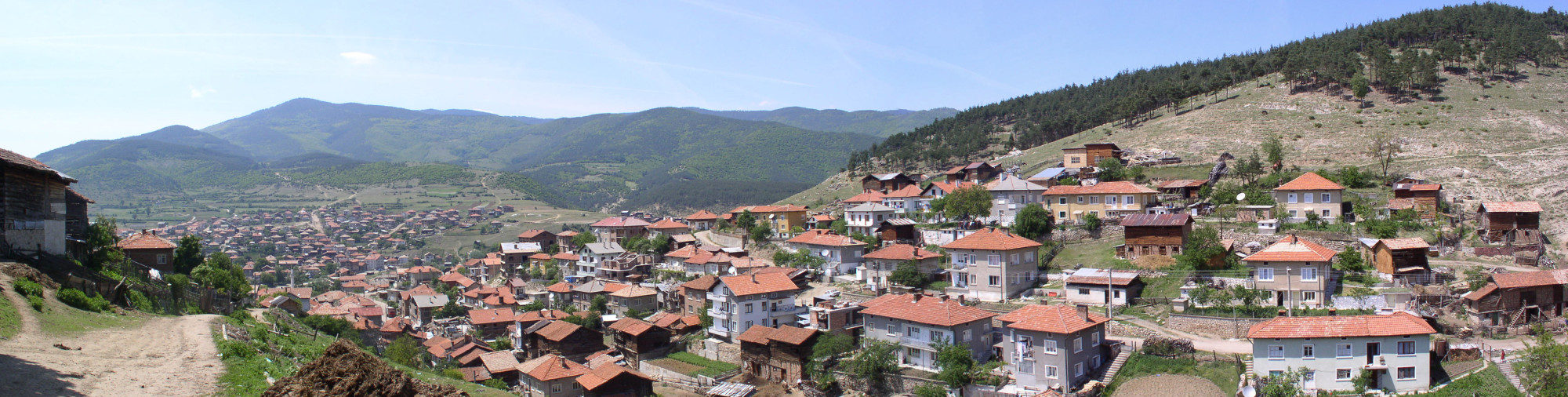
Lózen, Sófia region

Contrary to usual practice, though, I'm going to hold the song till I've talked about it a bit, because I think you'll get a lot more out of it after I tell you something about why I think it's so special.  I recorded the song in what was in 1980 the village of Górni Lózen.  Now there is only one town, Lózen, but in 1980 there was a little bit of a break in the houses between Dólni (Lower) and Górni (upper) Lózen.

The song, which the women said they used to sing when they started gathering (after the harvest was in) to spin, tells a very familiar story:

Two dragons are fighting in the mountains, from them flows a river that flows past Sofia to a dark dungeon.  No one is in the dungeon but the prisoner Gjúro, with a grey falcon on his arm.  He feeds the falcon with bits of his fingers, sheds tears to give him water, combs his hair to make a nest for the falcon.  The falcon asks why he is feeding him so well: "Are you planning to send me far away, or are you planning to use me in battle?"  Gjúro is not planning to do battle.  What he wants is to send the falcon to his home to see what's going on there.  The falcon has already been to his home, he says: "The yard is all overgrown with weeds, and in the weeds there is a dead tree.  On the tree sit three cuckoos.  One of them is your mother, calling you to breakfast; the second is your sister, calling you to dinner; the third is your wife, calling you to bed."

But now, listen to how they sing it!  The two parts barely diverge from each other...one part goes up a little while the other goes down a little, then they converge again—repeating this a few times to give the "melody":

Два се змея на планина бият (Dvá se zméja na planína bíjat), recorded in Górni Lózen, Sófia region, 1980

Listen closely, though, and you'll hear something fascinating!  There's really a lot of subtle detail in this very minimalist song.  The two groups sing different intervals: when the lead singer in the first group goes up to her higher note (which happens a number of times in each verse), at the beginning of the verse she goes up only a little bit (a half-tone), but later she goes up noticeably higher, even a full tone!  But the lead singer in the second group goes consistently to the same interval (only a half-tone).  Does this bother anybody?  Not a bit, as long as you are used to singing with the lead singer you're singing with!  Criss-cross the groupings of singers, though, and you'll get consternation and sometimes (when I first heard this I didn't really believe it, but it's true) COUGHING!  There's really a very physical component to this singing...

So, is this song "wow" because it is beautiful?  Yes, and no.  Personally, I find the minimal melody to be very compelling (incidentally, such melodies are considered to be among the most ancient).  And that subtle variation between the two groups of singers fascinates me  (Try to sing it, and you'll see just how fascinating it really is!)

Those who know Bulgarian and might find it interesting to listen to the discussion that precedes the song, in which one of the women gives the whole text, complete with commentary (they only sing part of it, though).   And here is the full Bulgarian text (in my somewhat messy hand-writing!)